

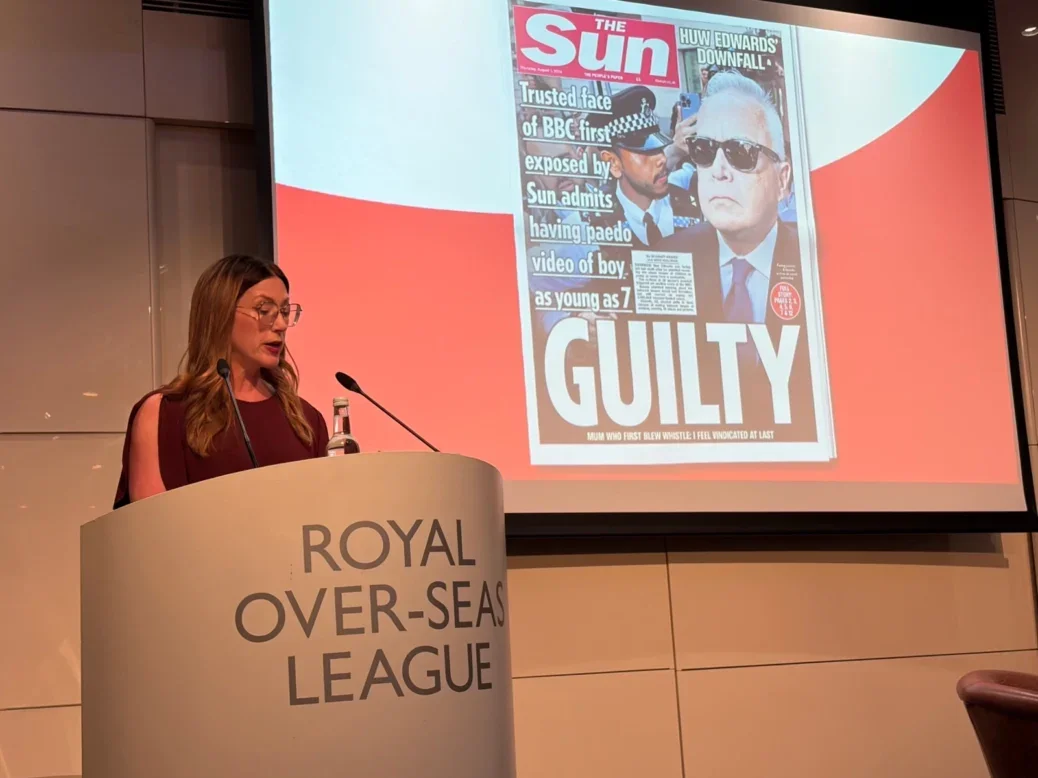
Sun editor-in-chief Victoria Newton said she is “optimistic” about the future after “reimagining the newsroom” and increasing video output.
Newton revealed the next phase of video from The Sun – news updates from a new studio on the newsroom floor – as she gave the Hugh Cudlipp Lecture in London on Thursday.
Newton said the new Sun Studios is beginning to put out “rigorous, professional journalism” in videos from “a whole new setting”.
She said audiences can hear about Sun scoops directly from the journalists behind them.
It is part of a drive to reach younger audiences who “want stories in a different form, with more personality: short, sharp, entertaining content from people who know what they are talking about”.
Newton said the video plan will not be “rolling news in the traditional TV mould.
“I think of it more as access-all-areas pass to The Sun, with Sun reporters on camera giving their expert insight into their own scoops.”
The Sun has already “aggressively” expanded its video operations since the start of 2025, increasing video staff by more than three-fold.
Much of that growth in content was part of Sun Originals, creating sponsorable episodic formats in genres like lifestyle and sport, although the team was also creating short breaking news videos and longer-form news shows on topics like royals and defence.
The new From The Newsroom style of videos on Youtube so far include: defence editor Jerome Starkey breaking down the latest debate over the Falklands Islands and business affairs editor James Flanders explaining the threat of a “deepening financial crisis”.
It has hired hosts Rhiannon Jones and Sam Homewood. Videos are also hosted on The Sun website and are typically around eight minutes long each.
Already, “as a deliberate commercial strategy”, Newton said, “our journalists are social media influencers in their own right.
“People might develop an online loyalty to the journalist first, with the brand to follow. Rather than the other way around.”
She cited The Sun’s recent scoops on the end of Katie Price’s marriage to Lee Andrews.
Assistant showbiz editor Clemmie Moodie and showbiz editor Ellie Henman “teased in advance when the next exclusive was coming” on social media, Newton said.
“In turn, that drove excitement and subscriptions to Sun Club – where there was more exclusive content available.”
The Sun launched its paid subscriptions offering Sun Club in February 2025, paywalling some of its content at a price of £1.99 per month.
Newton said she is “optimistic” about the future of popular journalism despite threats from disinformation, AI, “collapsing trust and business models under pressure”.
She said: “It would have been easy to despair at the huge changes in the way news is consumed, and simply look to manage decline.
“We have done the opposite – reimagining the newsroom, and producing engaging, original video content.
“We could have decided that in a world of noise, influencers and AI, our voice is not as significant as it once was.
“Yet we are campaigning harder than ever on behalf of our readers – and coming up with innovative new ways to make their voices heard.
“We are still at the centre of the national conversation: breaking stories, producing more opinions, which in turn drive the national conversation in pubs, work places and on social media. Entertaining people up and down the country – and across the globe.
“Yes, journalism is changing. But it is certainly not dying…”
Newton argued that critics of The Sun often “have not read it properly for years”.
“They are judging an older version of the paper, or a caricature of the popular press,” she said.
Newton cited The Sun’s campaigning work and announced the launch of the Local Legends awards in partnership with Prince William “to celebrate people who get off their backsides and do something for their communities”.
Drawing on the work of the wider press, Newton said: “Whether it is the Mirror’s expose of Partygate, or The Sunday Times breaking the story of Keir Starmer’s freebies or The Times exposing Fifa plans to sell off the World Cup.
“It’s a caricature of the popular press that we approach stories like these in a cavalier spirit.
“Really, nothing could be further from the truth.”
[Read more: Sun editor Victoria Newton says ‘we are the number one scoop machine on Fleet Street’]
Newton spoke about the threat to journalism from privacy law in the UK, saying: “Now, every serious call to publish has to be measured against a right to private life the courts have built since the Human Rights Act.
“Despite all that, there are still powerful people who would like the press to be more tightly controlled.
“They usually say this is about standards, or privacy, or responsibility. And sometimes it is.
“But sometimes it is really about those who have lived by publicity, deciding they don’t like scrutiny when the story turns against them.”
Newton also spoke about the “firestorm of abuse” she and her team received in response to The Sun’s revelations about Huw Edwards, before charges of having indecent images of children were brought against him.
She said it was the “toughest time in my career” but that she believes “only the popular press could have exposed this paedophile”.
[Read more: Sun editor Victoria Newton felt ‘quite lonely’ during Huw Edwards story scandal]
The Hugh Cudlipp Lecture, created and named in memory of the former editorial director of the Daily Mirror, is an annual platform for a senior media leader to share views on what’s going on in the media business.
Read Victoria Newton’s Hugh Cudlipp lecture in full:
Hello everyone.
It is an honour to be asked to give the Hugh Cudlipp Lecture.
You may think that as the editor of The Sun, I would feel some trepidation delivering a lecture named after a legendary editor of the Daily Mirror.
But Hugh Cudlipp is also a crucial part of The Sun’s history.
Back in 1964, he relaunched the Daily Herald under a new name, and five years later sold ‘The Sun’ to Rupert Murdoch, whose company still publishes it today.
So there is a nice symmetry in being here tonight, to talk about the craft Cudlipp understood so well: popular journalism.
Stories with purpose, reach and a bit of mischief, that millions of people want to hear about every day.
Everyone seems anxious about the future of journalism at the moment.
Disinformation and AI, collapsing trust and business models under pressure.
I understand all of that. But I am optimistic.
Popular journalism is more important today than ever and, contrary to the prevailing view, I think it has a bright future.
I have worked in the popular press all my professional life.
As a teenager I was obsessed with current affairs.
My parents – who were teachers from Liverpool, so not exactly your classic Sun family – took the Mirror and Guardian.
But I haven’t let that difficult start in life hold me back.
This was the 1980s.
It was a man’s world, but Margaret Thatcher was in Number 10, showing that women can be every bit as tough at the top as men.
I remember watching Kate Adie reporting from Tiananmen Square, and seeing that women in journalism could do difficult jobs in dangerous places.
I studied politics at university, worked on the student paper, and I was determined to get to Fleet Street.
I wrote to every paper begging them for a job.
The Daily Express replied and said that they had a graduate training scheme, so I joined it and moved to London.
I did a bit of everything: news, diary, subbing.
As a politics graduate, the lobby was a dream.
I was sitting in the Downing Street rose garden on the day that John Major resigned as leader of the Conservative Party – a ringside seat to history.
And because I was a 23 year old woman living in London in the ‘90s, I of course enjoyed a lot of great nights out.
If it was John Major resigning in the Rose Garden in the morning, it might well be a celebrity falling out of the toilets of the Groucho Club in the evening.
And funnily enough, they were both great stories.
Show business reporting – like the lobby- teaches you very quickly whether you have what it takes to be a journalist.
You need nerve.
To know when someone is spinning you.
To be able to read a room.
Sometimes, you physically need to get yourself into the room…
…even if that means clambering in through a window, as I may once have done at an Oscars party.
My big break was taking on The Sun’s Bizarre column, THE great showbiz column.
Drinking champagne with celebrities and then getting paid to gossip about them might sound more like fun than work.
It was fun. But it was also real, proper journalism.
And it gave me moments I still cannot quite believe happened.
I once interviewed Yoko Ono and Paul McCartney – the best of enemies at the time – on the same day, desperately hoping one wouldn’t find out in advance that I was seeing the other.
Pop stars would regularly ring the Bizarre phone line to speak to me – either to say thanks for a positive story – or to try and bollock me for one that wasn’t flattering.
Once I wrote that Robbie Williams’ Rudebox song was “ the worst single in history”.
The story was followed up enthusiastically by then Radio 1 breakfast show host Chris Moyles and became part of a national debate.
Later that afternoon, a clearly miffed Robbie rang the Bizarre phone, to invite me out to Austria, where he was on tour, to do an interview (and listen to the rest of the album).
I flew out there, we talked for three hours – and it became a series of exclusives splashed all over The Sun the following week.
We were showbiz pals again! … so much so, he invited me to his hotel suite recently for drinks on the night of his Netflix documentary premiere.
Kissing and making up is all part of the surreal world of being a showbiz reporter – and Robbie very much understood the game.
I have been lucky enough to meet Madonna five or six times over the years.One of those meetings was a personal concert, of sorts.
She was rehearsing the second leg of her Sticky and Sweet tour at the O2, and I was allowed to sit in.
Just me, in a chair, in the middle of an empty auditorium, while Madonna gave her dancers hell for not being bang on it.
It went on until the early hours.
I was meant to interview her afterwards in her dressing room, but by now it was one in the morning.
I knew it was not the moment.
She can be pretty terrifying in person.
But Michael Jackson had died just weeks before, and she had known him well.
So, I was not leaving without that interview.
I told her, as forcefully as I dared, that I would be calling her the next day.
She called me! And I got the interview.
Never leave without the story.
In every newsroom I have ever worked in, the phrase you want to hear is still the same: “You’ll never guess what.”
Closely followed by: “What a story.”
And whether it’s Alastair Campbell spinning on behalf of Tony Blair, or some poor PR trying to get a celebrity out of trouble, for the journalist it’s the same set of instincts you draw on.
Politics and popular culture are not separate worlds to most people.
Showbiz is really just politics for beautiful people, after all. Or politics is showbiz for ugly people. Take your pick.
… They are part of the same national conversation.
Sun readers care about crime, the economy and tax.
They also care about football, TV, music, holidays and what people are talking about at work.
Jeremy Clarkson, our most popular columnist, always says that when people finish reading The Sun, they should have a smile on their face.
We reflect the whole of real life back to readers, not just the things which make you feel miserable!
When I became editor of The Sun, just before the pandemic, the job was already changing fast.
But the past six years have transformed it completely.
When I started, I still spent most of my time editing the printed paper in the traditional way.
Morning conference. Ideas. News list. Sitting on the backbench. Deciding on the front page. The old rhythm of Fleet Street.
I still worry about all of those things.
And millions of people still buy a paper each morning.
We work hard each day to make it a quality product.
But The Sun is no longer only a newspaper.
We are a multi-platform content-creating machine, with the newsroom at the spine of the operation.
And our reach is greater today than at any point in our history.
We serve millions of people around the world on our owned platforms, and more and more all the time off-platform, across YouTube, TikTok, Facebook and Instagram.
When I started, journalists were a by-line and columnists were a headshot.
Today, as a deliberate commercial strategy, our journalists are social media influencers in their own right.
People might develop an online loyalty to the journalist first, with the brand to follow. Rather than the other way around.
Today’s newsroom works around subjects and audiences.
Take the story that people – including politicians I might add – have asked me about more than any other recently – the saga of Katie Price and Lee Andrews.
Is he all he seems, and does Katie know all the facts? Surely she KNOWS he’s a conman? And is she IN on it all?
It has all the ingredients of a classic popular story: celebrity, money, romance and suspicion.
Our reporter Clemmie Moodie was right in the thick of it.
We broke the story first on socials, then it took off online, and finally moved into print. On social media, Clemmie and Showbiz Editor Ellie Henman teased in advance when the next exclusive was coming.
In turn, that drove excitement and subscriptions to Sun Club – where there was more exclusive content available.
That is the modern rhythm of a popular newsroom, and it’s completely different from the one I learnt as a trainee at City University.
But the core question has remained exactly the same.
What do people want to know?
And how can we tell them about it?
One of the funny things about editing The Sun is that many people who have the strongest opinions about it have not read it properly for years.
They are judging an older version of the paper, or a caricature of the popular press.
I have lost count of the number of times I have had to tell people we stopped running Page Three models over a decade ago.
As Britain changes, of course The Sun changes too.
Because our job is to reflect modern Britain.
We still call out hypocrisy, we still have a sense of mischief.
And we will always campaign on issues that matter to readers.
Our fuel duty campaign, Keep it Down, has given successive Chancellors sleepless nights.
For years, we have worked on domestic abuse with Women’s Aid.
Our Who Cares Wins awards turned gratitude to NHS and care workers into a big national moment.
It was very Sun.
Famous people celebrating people who are not famous.
Millions of viewers seeing those who had looked after the country treated as stars.
And tonight – I can announce – our next campaign in that tradition.
We will soon be launching a new ‘Local Legends’ awards, in partnership with Prince William, to celebrate people who get off their backsides and do something for their communities.
That is very Sun too: famous names helping to shine a light on people who really do deserve to be famous.
The Sun can still do things that very few news organisations can do.
I learned that during the pandemic.
It is a story of two front pages.
As I have said, I became editor only weeks before Covid hit.
It was a strange time.
When Boris Johnson went into intensive care there was a huge intake of breath in the newsroom.
Whatever your politics, the Prime Minister being in intensive care was shocking.
Calls and emails from readers went through the roof.
People were scared and we became part of a public information service.
We were hearing directly from people who felt forgotten: supermarket workers stacking shelves, risking their health to keep the country fed; care workers, delivery drivers, cleaners, people keeping the country going.
Popular journalism matters because it gives a voice to people who are not always heard.
As a patriotic paper, we supported the national effort.
That meant working closely with the government, at the time it was Matt Hancock at health.
I’ll come back to him in a minute.
Once the vaccines appeared, we all knew they were the route out of lockdown.
But it was going to take a huge operation to roll them out.
The Royal Voluntary Service needed 30,000 volunteers to work as stewards at vaccination centres.
I knew that we could make a difference, so The Sun did what The Sun can do.
They needed 30,000.
We recruited, 50,000.
I will never forget going to Epsom Racecourse, one of the early vaccination centres, staffed by Sun volunteers.
There were people in their eighties and nineties coming in for their jabs.
Many had barely left their homes in months.
Some were in tears because they were getting their freedom back. Our staff, an army of readers and celebrities like Vernon Kay mucked in and played their part.
It was one of the proudest things I have been part of.
And The Sun was uniquely placed to do it.
It was an example of the power of popular journalism.
Of course, real journalism is also about holding power to account.
Which brings me back to Matt Hancock – and front page number two.
During the pandemic, I got to know Hancock.
We were trying to get health messages to our readers, so we had a working relationship.
Then a tip came in about what he had been caught doing on CCTV in his government office.
There were two clear public interest points: an aide on the government payroll, and the Health Secretary breaking his own rules.
There were also huge legal risks.
The Official Secrets Act was talked about, because the footage was recorded in a government building.
Of course, there was no way we’d ever reveal our sources if they used the Act to ask.
So, I had to make the call that would end Hancock’s career – and could have got me locked up too!.
I sent him a message saying he needed to speak to me urgently and in private.
He didn’t call back for ages.
A piece of advice: if you get that kind of message from the Editor of The Sun, call back straight away.
When I eventually spoke to him, I told him what we had. He didn’t deny it.
The story went live and he was forced to resign a couple of days later.
That’s the other side of the coin of what a free popular press does.
We helped Hancock when the national interest required it, and we exposed him when the public interest required that.
No contradiction there.
We should be proud to live in a country where the powerful are held to account in that way.
Whether it is The Mirror’s expose of Partygate, or the Sunday Times breaking the story of Keir Starmer’s freebies or the Times exposing Fifa plans to sell off the World Cup.
It’s a caricature of the popular press that we approach stories like these in a cavalier spirit.
Really, nothing could be further from the truth.
I edit in a legal landscape my predecessors would barely recognise.
For most of the last century there was almost no privacy law in this country.
Now, every serious call to publish has to be measured against a right to private life the courts have built since the Human Rights Act.
Despite all that, there are still powerful people who would like the press to be more tightly controlled.
They usually say this is about standards, or privacy, or responsibility.
And sometimes it is.
But sometimes it is really about those who have lived by publicity, deciding they don’t like scrutiny when the story turns against them.
Of course, there must be rules and standards.
But the answer can never be a system where politicians, celebrities or the state decide what counts as news.
The Huw Edwards story showed that very clearly.
Let me tell you what it felt like from the editor’s chair.
We had been receiving tip offs about Huw Edwards from 2017.
They were mostly people telling us that he was gay and messaging young men on social media.
We decided there was no public interest in reporting someone’s private sexuality.
Then two parents came to us with a different story.
An extremely vulnerable young person was receiving thousands of pounds from Edwards in exchange for sending intimate images, and then using that money to fuel a drug habit.
The parents just wanted the payments to stop.
They had gone to the BBC.
They had spoken to the police.
But nothing had happened.
They felt they had nowhere else to go, so they came to us.
We published.
We had ample evidence.
Texts, WhatsApps, social media messages, bank statements.
We treated the story with the utmost seriousness and care.
I had KCs round the table and a cottage industry of media lawyers to go through it properly.
We did not name Edwards and we did not identify the young person’s gender, so that we didn’t reveal the subject’s sexuality.
We were mindful of privacy, of the vulnerability of the young person, Edwards’ family and his mental health.
We were also mindful of the public interest in how the face of the British national broadcaster – the man who presided over state occasions – was conducting himself.
BUT once Edwards was named by his wife – the backlash came.
It was a firestorm of abuse directed against The Sun, and me, by the great and the good of the British media establishment.
Friends of Edwards rushed into outbursts of sympathy for him on X and did their best to trash the story.
More than one media grandee called for my resignation.
The BBC laid siege to us on the 6 and 10.
They breathlessly ran a denial issued by the young person’s lawyer, which turned out to be completely untrue, without doing basic journalistic checks on its provenance.
We had evidence which backed up every word of our story, which we shared with the BBC investigation.
But given Edwards’ family had said he was being treated for his mental health – we decided not to publish it.
That meant absorbing the criticism, for over a year, while holding back material that would have vindicated our position.
That is one of the hardest places to be as an editor.
And it was the toughest time in my career, no question.
When your Dad rings you up to check you’re okay because he’s seen you on the 10 o’clock news, you know things are serious.
It requires resilience because, in the end, the decision is on you.
But it also impacts your whole team, who – despite being hardbitten journalists – are human beings too.
And this went on for months and months.
We had full confidence in our story, but I wasn’t sure we’d ever be vindicated.
Then we started getting tip offs that Edwards had been arrested and was facing serious charges.
The Met and the CPS refused to confirm anything.
Despite the principle of open justice, despite the fact that publicity can encourage more victims to come forward, there was a code of silence that kept the public totally in the dark.
Finally, we got a tip off to say that Edwards’ name was on the court list for Westminster Magistrates Court.
We checked, and there he was, charged with vile crimes.
We broke that story too, and then we revealed the full truth of Edwards’s criminality.
The family did eventually get an apology from then BBC Director General Tim Davie.
But most of those who had rushed to defend Edwards were strangely silent.
Only the popular press could have exposed this paedophile.
And, while saddened, I am proud that we were brave enough to publish it.
Good popular journalism is loud, in your face, mischievous, entertaining.
It also has the professionalism to pursue difficult stories and the discipline to check them rigorously.
Of course the popular press has got things wrong in the past.
And we have been held to account for it. That is the point.
When we publish, we put our reputation behind every word, and we answer for it, in law, to our regulator, and to our readers.
In an era where more and more people get their news from social media, and the internet is awash with AI slop, that accountability is precious.
Professional journalism has to be present, in force, on every platform where people get their news.
And that is where the popular press has a new and essential role.
Generating mass-reach content that is entertaining, trustworthy and designed to compete for attention in the fee, is our home turf.
Beating AI slop with journalism people actually want to watch and share is a job made for the popular press.
And that journalism has to be paid for.
AI systems and social media algorithms depend on current, verified information that does not appear by magic.
It comes from paid journalists doing the work.
So if the tech companies want the benefit of it, they have to license it and pay for it.
This month, The Sun is taking rigorous, professional journalism into a whole new setting.
We will be launching Sun Studios from the newsroom floor. Not rolling news in the traditional TV mould.
I think of it more as access-all-areas pass to The Sun, with Sun reporters on camera giving their expert insight into their own scoops.
We have a newsroom full of people with amazing knowledge, contacts and judgement.
They are breaking agenda-setting stories every day.
Sun Studio viewers will be the first to hear about them, directly from our journalists.
That is key for younger audiences.
They don’t come to us by picking up a paper.
But they see our journalism on TikTok, YouTube, Instagram.
For them, the thumbnail is more important than the front page.
They want stories in a different form, with more personality: short, sharp, entertaining content from people who know what they are talking about.
It is the modern version of the oldest skill: know your patch, know your audience and give them what they want, where they want it.
At the beginning, I said I was optimistic. I hope you can now see why.
It would have been easy to despair at the huge changes in the way news is consumed, and simply look to manage decline.
We have done the opposite – re-imagining the news room, and producing engaging, original video content.
We could have decided that – in a world of noise, influencers and AI – our voice is not as significant as it once was.
Yet we are campaigning harder than ever on behalf of our readers – and coming up with innovative new ways to make their voices heard.
We are still at the centre of the national conversation: breaking stories, producing more opinions, which in turn drive the national conversation in pubs, work places and on social media. Entertaining people up and down the country – and across the globe.
Yes, journalism is changing. But it is certainly not dying, which is why YOU, too, should be optimistic.
There are brilliant careers to be had in journalism. Not easy careers. I would never pretend that.
It is highly competitive. At times it will try to take over your life.
But it is the best job in the world.
Where else do you get to be in the middle of things?
To ask questions of prime ministers, pop stars, footballers, whistleblowers, ordinary people with extraordinary stories.
Popular journalism has survived every time people said it was finished because the human need for stories has not changed.
From the front page to the news feed, people still want to know what is going on.
They still want someone they trust to tell them.
And they still want to have be entertained.
As long as they do, we will be there for them.
Email pged@pressgazette.co.uk to point out mistakes, provide story tips or send in a letter for publication on our "Letters Page" blog
